
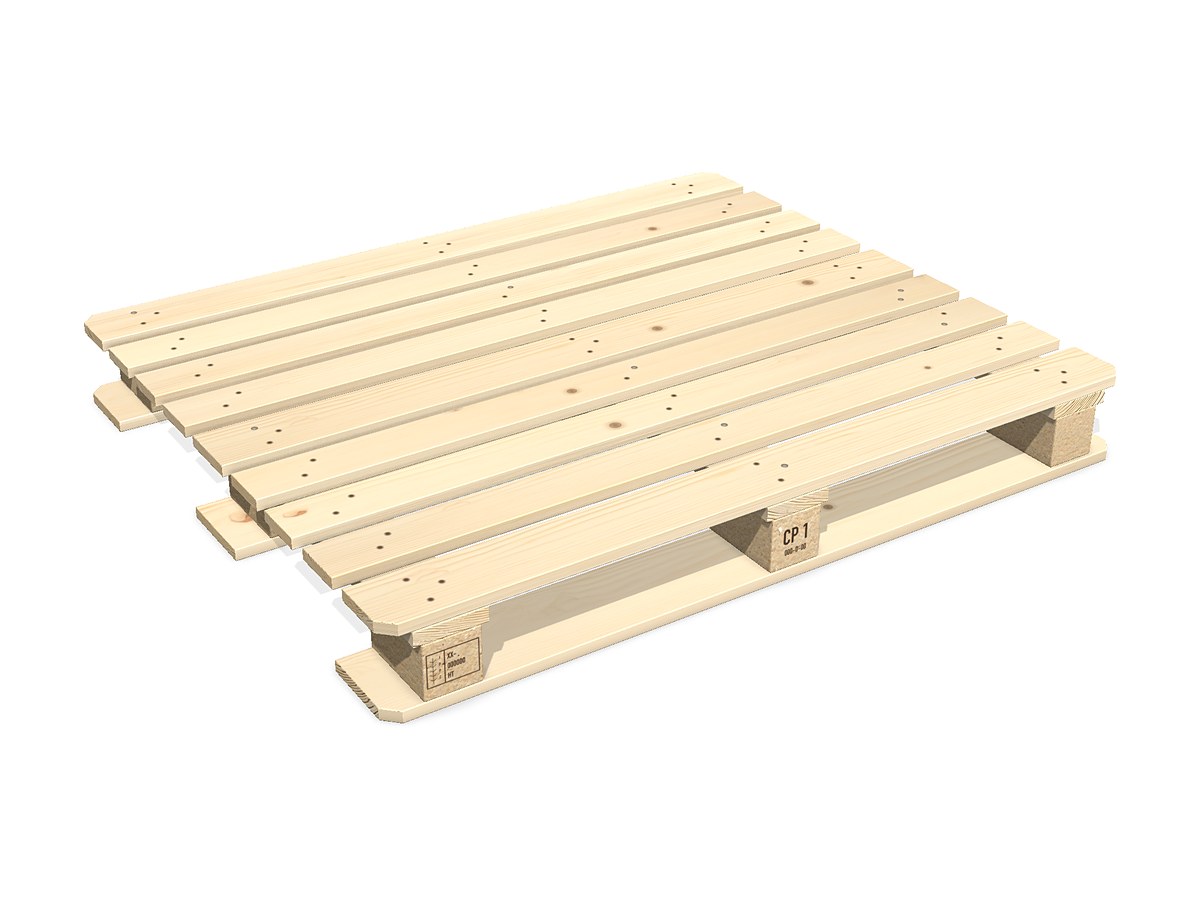
CP pallet vs EUR pallet is a question that usually comes up because of a customer requirement. A buyer in the chemical or plastics industry states that the goods must arrive on CP pallets, and the supplier wonders whether a familiar EUR or FIN pallet would do after all. The short answer is no, and the reason is not the dimensions but the system.
This article explains where CP pallets come from, the three decisive ways in which they differ from a EUR pallet, when a CP pallet is the only option and what to do when they build up in your warehouse. Dimensions, load capacities and markings are collected separately on the CP pallets page.
In short: A CP pallet is the chemical and plastics industry’s own standard pallet, with its own specification, its own dimensions and its own marking. A EUR or FIN pallet cannot replace it, even though CP1 is the same size as a FIN pallet.
The most important practical difference is exchange: a CP pallet is not swapped for a EUR pallet, so CP pallets circulate separately in the supply chain and build up at the recipient’s end. In January 2026, EPAL announced that it is bringing CP pallets into the EPAL pallet pool, so it is worth checking whether your customer requires EPAL CP pallets.
Where CP pallets come from
The CP pallet system was set up by the German Chemical Industry Association (VCI) in 1991, and its administration later passed to the plastics industry association now known as PlasticsEurope. The background was a practical problem: chemicals and plastic raw materials move in sacks, drums, big bags and octabins, and these loads do not behave like boxed goods. They are heavy, their centre of gravity shifts and some of them are soft and bulge.
The solution was to define nine pallet types with precise dimensions and construction. Roughly, they divide as follows:
- CP1-CP5 are chemical industry pallets, typically for sacks, boxes and drums
- CP6-CP9 are plastics industry pallets, built to withstand heavy and stackable loads
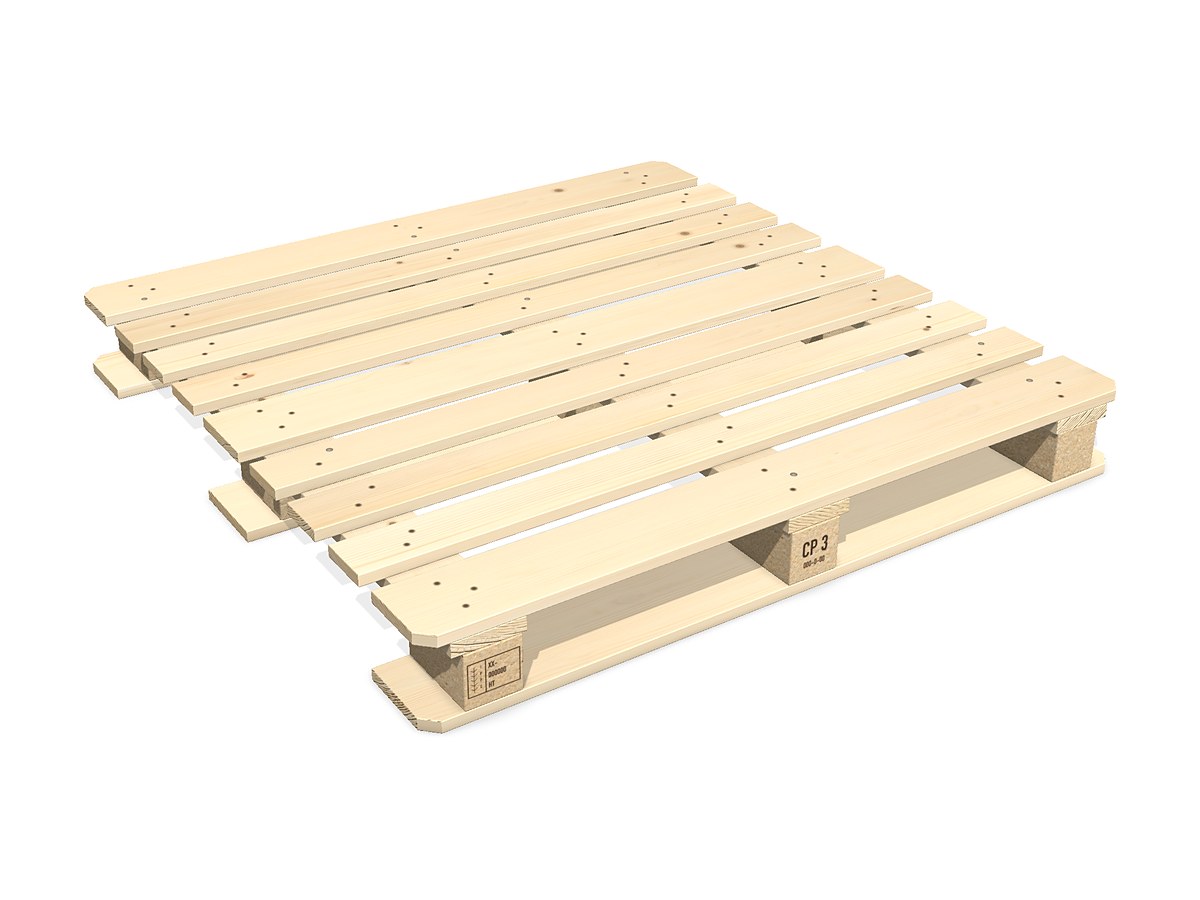
In Finland the most common ones are CP1, CP3 and CP9. Their dimensions and load capacities are collected on the CP pallets page.
Three differences between a CP pallet and a EUR pallet
1. Dimensions and shape
A EUR pallet is 800 x 1200 mm and a FIN pallet 1000 x 1200 mm, so both are rectangular. CP1 has the same dimensions as a FIN pallet, but CP3 and CP9 are square, 1140 x 1140 mm. The square shape is no accident: it was chosen to match the width of a shipping container, so that two pallets fit side by side without wasted space.
2. Exchange system
In practice this is the most important difference. A EUR pallet is an exchange pallet: the recipient can hand over another equivalent EUR pallet in its place, and the pallet circulates in an open pool. CP pallets do not work like this. They are repairable and reusable, and in many supply chains they circulate in a closed loop between the producer and the processor, but they are not exchanged for EUR pallets, nor are EUR pallets exchanged for them.
Two things follow from this. Firstly, you need CP pallets in your own stock when a customer requires them. Secondly, CP pallets build up at the receiving end and cannot be returned through an exchange. The logic of pallet exchange and deposit systems is explained in the article should you buy or rent pallets.
3. Markings and variation in quality
A CP pallet carries its own identification mark, and pallets going for export also carry the ISPM 15 marking. The requirement applies to all wooden packaging material in shipments leaving the EU, and since Brexit also to shipments going to Great Britain. Heat treatment and the IPPC stamp are explained in the article heat-treated pallets and ISPM 15.
CP pallets have had one well-known weakness: quality has varied from one manufacturer to another, because the system did not have the same kind of quality control as EPAL pallets. That is why in 2018 EPAL started producing quality-assured EPAL CP pallets, whose share has grown especially in international supply chains. In January 2026, EPAL announced that it is bringing CP pallets into the EPAL pallet pool, and several large chemical companies have said they will only use EPAL CP pallets from 2026 onwards. For the buyer, this means that when ordering CP pallets it is worth asking where the pallets come from and how their condition has been inspected.
| Aspect | EUR pallet | CP pallet |
|---|---|---|
| Behind the standard | EPAL and the railway organisations | The chemical industry, today PlasticsEurope |
| Shape | Rectangle, 800 x 1200 mm | CP1 rectangular, CP3 and CP9 square |
| Exchange | Exchanged in an open pool | Not swapped for EUR pallets, circulates in the supply chain |
| Typical load | Boxes, mixed general cargo | Sacks, drums, big bags, octabins |
| Who requires it | Rarely anyone specifically | Customers in the chemical and plastics industry |
| Availability | Continuous, large volumes | Must be ordered separately, smaller circulation |
When a CP pallet is the only option
You need a CP pallet when someone other than you has decided so. There are four typical situations:
- The customer’s purchasing terms or delivery instructions specify a CP pallet or a particular CP type
- The goods are going to a chemical or plastics industry plant whose goods-in and automation are designed for CP pallets
- The load consists of big bags, drums or octabins, for which a square pallet is in practice the only workable base
- The shipment goes into a shipping container, where a square pallet fills the width without waste
If none of these applies, an ordinary EUR or FIN pallet is almost always cheaper and easier to get. Choosing a pallet type more generally is covered in the article how to choose the right pallet for different uses.
When a EUR or FIN pallet is enough
There is no point ordering CP pallets just to be on the safe side. They are a specialist product with a smaller circulation and more variable availability than standard pallets. A EUR or FIN pallet is enough when
- the customer has not specified a pallet type
- the load consists of boxes or other goods that stay on the pallet without special support
- the delivery is within Finland and is not going to a chemical industry goods-in
- you want to get the pallets back through an exchange
The difference between EUR and FIN pallets is explained in the article what is the difference between EUR and FIN pallets.
What happens if you ship on the wrong pallet
The wrong pallet type is not a formality. It shows up immediately at goods-in. The consequences are usually one of these:
| Situation | Consequence |
|---|---|
| Goods-in requires CP pallets, the goods arrive on EUR pallets | The load may be rejected or have to be re-palletised at the sender’s expense |
| The pallet does not fit the recipient’s automation | Handling slows down and has to be done manually |
| A square pallet is replaced with a rectangular one in a container | Load space goes unused and the freight cost per unit rises |
| An export shipment is missing the ISPM 15 marking | The shipment may be held at customs |
| Someone tries to exchange a CP pallet for a EUR pallet | The exchange fails and the pallets stay with the recipient |
The practical advice is simple: confirm the pallet type when the order is placed, not when the goods are being loaded.
How many CP pallets fit in a truck
The square shape helps in a shipping container but not in road transport. The load space of a truck is about 2.4 metres wide inside and a semi-trailer is 13.6 metres long, so the space is designed for pallets 1200 millimetres deep. With a pallet of 1140 x 1140 mm, two fit side by side and eleven rows fit lengthways.
| Pallet | Dimensions | Single layer in a semi-trailer |
|---|---|---|
| EUR pallet | 800 x 1200 mm | about 33 |
| CP1 | 1000 x 1200 mm | about 26 |
| CP3 and CP9 | 1140 x 1140 mm | about 22 |
The difference is significant: a third fewer square pallets than EUR pallets fit into the same load space. If the goods first travel by road and only then go into a container, it is worth calculating both legs. In a container the square pallet wins; on the road it loses.
Filling the load space and how freight costs are made up are explained in more detail in the articles how many pallets fit in a truck or container and pallet transport and freight costs.
Why a CP pallet costs more than a standard pallet
A CP pallet is a specialist product, and that shows in the price. There are three reasons. Firstly, the circulation is smaller: clearly fewer used CP pallets come onto the market than EUR and FIN pallets, so they are not always ready on the shelf. Secondly, the pallet cannot be replaced with another type, so the buyer cannot switch type to get a better price. Thirdly, the square pallets have a footprint about a third larger than a EUR pallet, so they use more timber.
Does a pallet collar fit on a CP pallet?
This comes up surprisingly often, and the answer depends on the CP type. The most common standard collars are 800 x 1200 mm and 1000 x 1200 mm, so they match the base of a EUR pallet and a FIN pallet.
- CP1 is 1000 x 1200 mm, so a FIN pallet collar fits on it
- CP3 and CP9 are 1140 x 1140 mm, and no standard-size collar covers the square base
In practice this means that if the load needs to go inside collars and be closed with a lid, a square pallet is the wrong choice unless the customer specifically requires it. If, on the other hand, you have to use CP3 or CP9 pallets, the load is protected with shrink film, strapping or a made-to-measure frame, not with collars. Collar dimensions and uses can be found on the pallet collars page.
Surplus CP pallets: what to do with them
Because CP pallets are not swapped for EUR pallets, they build up wherever the goods go. A company that receives chemicals and plastic raw materials may have dozens of CP pallets sitting in a corner that it has no use for, because the company’s own outgoing goods travel on EUR or FIN pallets.
These pallets are not waste. A CP pallet is repairable and reusable, and there is demand for it among companies that ship goods to the chemical and plastics industry. So it makes sense to sell intact CP pallets on, just like any other surplus pallets. The options are covered in the article what to do with old pallets, and the practicalities of selling in the article how to sell your company’s surplus pallets.
When selling CP pallets, keep three things in mind:
- Keep CP pallets separate from other pallets, because they are assessed as a type of their own
- State the CP type, that is whether they are CP1, CP3 or CP9 pallets, because demand varies by type
- Store the pallets in a dry place, because moisture destroys the value of a CP pallet just as quickly as that of any wooden pallet
CP pallet vs EUR pallet: a quick decision rule
When you need to decide quickly, four questions are enough. Go through them in order and stop at the first one you answer yes to.
| Question | If yes |
|---|---|
| Does the customer or the delivery instruction require a particular CP type? | Order exactly that type, nothing else will do |
| Are the goods going to a chemical or plastics industry goods-in? | Confirm whether CP pallets are needed before loading |
| Does the load consist of big bags, drums or octabins? | A square pallet, i.e. CP3 or CP9, is usually right |
| Is the shipment going into a shipping container? | A square pallet fills the width of the container without waste |
| No to all of these | A EUR or FIN pallet is enough |
The rule also works the other way round. If nobody has asked for CP pallets and the load does not require a square shape, ordering CP pallets adds cost without any benefit. So the choice between a CP pallet and a EUR pallet is almost always settled by the recipient’s requirements, not by your own preference.
Availability varies more than with standard pallets
EUR and FIN pallets circulate constantly in Finland across every industry, so they are practically always available. CP pallets come from a narrower stream: they arrive with deliveries from the chemical and plastics industry and build up at the companies that receive batches of raw materials. That is why availability varies by type and over time, and you may have to wait for a less common type.
For purchasing, this means two things. State the type and quantity in your very first enquiry, because the word CP on its own is not enough to check stock levels. If the delivery instruction allows more than one type, say so, because the order can then often be filled faster from two batches.
If you ship regularly, it is worth agreeing your needs in advance one season or quarter at a time. A forecast need is easier to cover than a one-off urgent request, and you also avoid the situation where the load is packed and ready but the right pallet is nowhere to be found.
How to make sure you get the right CP pallets
- Check the exact CP type in the customer’s purchasing terms or delivery instructions. CP1, CP3 and CP9 are not interchangeable.
- State the quantity you need and the delivery frequency. CP pallets have a smaller circulation than standard pallets, so it is worth confirming availability in good time.
- Say whether the goods are going outside the EU. In that case the pallets must carry the ISPM 15 marking.
- Agree whether the pallets will be new or used and what condition the used ones must be in.
- Ask whether the CP pallets that have built up at your site can be collected on the same visit.
Do you need CP pallets, or have they built up in your warehouse? Suomen Lavacenter supplies CP1, CP3 and CP9 pallets, and we also buy them from companies. Tell us the type and quantity, and we will let you know about availability or send you a quote and arrange collection.
See CP pallets, request a quote, sell your pallets to us or call +358 29 170 3899.
Summary: CP pallet vs EUR pallet
A CP pallet is the chemical and plastics industry’s own standard pallet, and a EUR or FIN pallet cannot replace it, even though CP1 is the same size as a FIN pallet. The decisive difference is not the dimensions but the fact that CP pallets are not exchanged for EUR pallets. They circulate in the supply chain and build up at the recipient’s end.
Order CP pallets when the customer, the type of load or the container requires them. In other cases a standard pallet is cheaper and easier to get. And if CP pallets have built up in your own warehouse, it makes sense to sell them on, because there is demand for them.
- CP pallets: CP1, CP3 and CP9
- What is the difference between EUR and FIN pallets
- How to choose the right pallet for different uses
- Heat-treated pallets and ISPM 15
- What to do with old pallets
- Should you buy or rent pallets
Frequently asked questions
What is the difference between a CP pallet and a EUR pallet?
A CP pallet is the chemical and plastics industry’s own standard pallet, with its own specification, its own dimensions and its own marking. A EUR pallet is 800 x 1200 mm and circulates in an open exchange pool, whereas a CP pallet is not swapped for a EUR pallet.
Can a FIN pallet be used instead of a CP1 pallet?
No. CP1 has the same dimensions as a FIN pallet, 1000 x 1200 mm, but its construction and markings come from the CP specification. If the customer requires a CP1 pallet, a FIN pallet does not meet the requirement.
Why are CP3 and CP9 square?
The square shape of 1140 x 1140 mm was chosen to match the width of a shipping container, so that two pallets fit side by side without wasted space. The shape also suits drums and big bags.
Can a CP pallet be exchanged for a EUR pallet?
No. A CP pallet, including an EPAL CP pallet, is its own pallet type and is not swapped for a EUR pallet. In practice this means that you need CP pallets in your own stock when a customer requires them, and that they build up at the receiving end.
Who are CP pallets intended for?
Types CP1-CP5 are chemical industry pallets and CP6-CP9 are plastics industry pallets. In Finland the most common ones are CP1, CP3 and CP9.
When do I need a CP pallet?
When the customer’s purchasing terms say so, when the goods are going to a chemical or plastics industry goods-in, when the load consists of big bags or drums, or when the shipment goes into a shipping container where a square pallet fills the width.
What happens if I ship goods on the wrong pallet?
The load may be rejected or have to be re-palletised at goods-in, handling slows down, load space goes unused, or an export shipment is held at customs if the ISPM 15 marking is missing.
Do CP pallets need the ISPM 15 marking?
Yes, when the shipment goes outside the EU. The requirement applies to all wooden packaging material, and since Brexit also to shipments going to Great Britain.
What is an EPAL CP pallet?
The quality of CP pallets has varied between manufacturers, because the system did not have uniform quality control. In 2018 EPAL started producing quality-assured EPAL CP pallets, and their share has grown in international supply chains. In January 2026, EPAL announced that it is bringing CP pallets into the EPAL pallet pool.
Do you buy used CP pallets?
Yes, we do. A CP pallet is repairable and reusable, and there is demand for it among companies that ship goods to the chemical and plastics industry. Keep CP pallets separate from other pallets and state the type so that the batch can be assessed.
How should CP pallets be stored before collection?
In a dry place and in straight stacks, preferably indoors or under a roof on a raised base. Moisture destroys the value of a CP pallet just as quickly as that of any wooden pallet.
Where does the CP pallet system come from?
It was set up by the German Chemical Industry Association (VCI) in 1991, and its administration later passed to the plastics industry association now known as PlasticsEurope. The background was the need for uniform pallets for sacks, drums, big bags and octabins.
How many CP pallets fit in a truck?
A semi-trailer takes about 22 square CP3 or CP9 pallets in a single layer, about 26 CP1 pallets and, for comparison, about 33 EUR pallets. A square pallet is efficient in a shipping container but takes up more space in road transport.
Is a CP pallet more expensive than a EUR pallet?
Usually, yes. A CP pallet is a specialist product with a smaller circulation, it cannot be replaced with another pallet type, and the square CP3 and CP9 pallets use more timber than a EUR pallet.
Does a pallet collar fit on a CP pallet?
A FIN pallet collar fits on a CP1 pallet, because both have a base of 1000 x 1200 mm. There is no standard collar for CP3 and CP9 pallets, because standard collars are rectangular, most commonly 800 x 1200 and 1000 x 1200 mm, and they do not cover a 1140 x 1140 mm square.
Where can I get CP pallets in Finland?
Suomen Lavacenter supplies CP1, CP3 and CP9 pallets. Tell us the type and quantity you need and whether the goods are going for export, and we will let you know about availability.


