
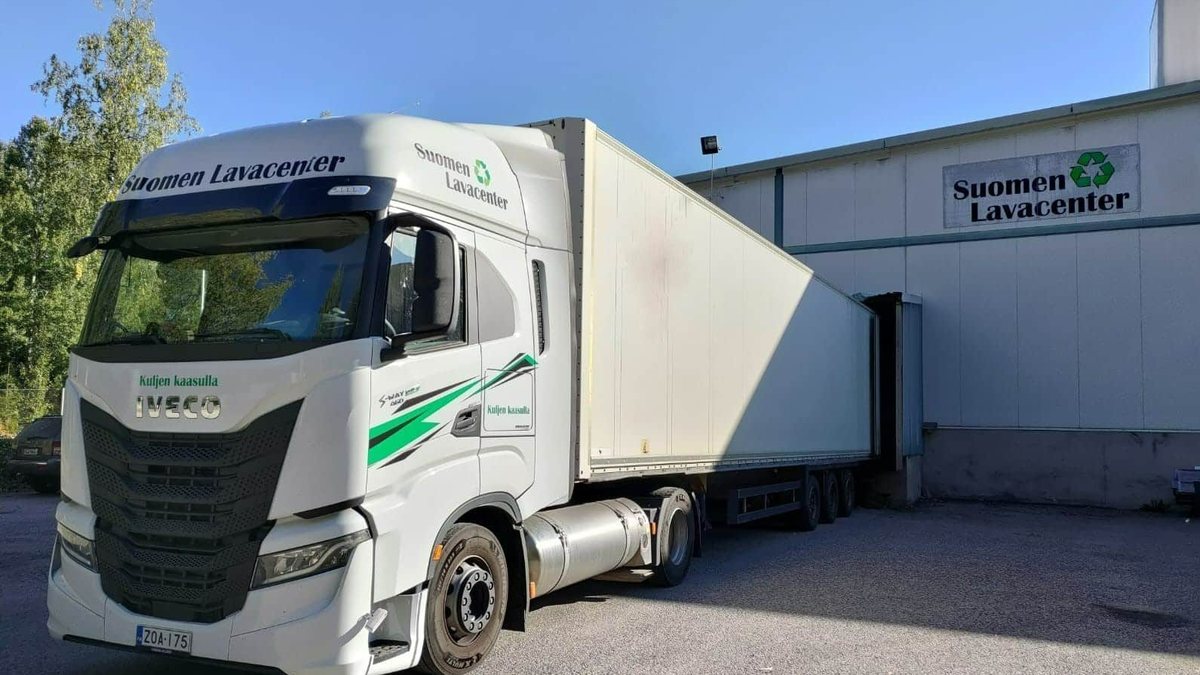
Pallet transport is rarely a single price. It is the outcome of six decisions, most of which are made by the customer rather than the haulier. Together, batch size, pallet type, stackability, conditions at the unloading site, the schedule and any extra services you order make up your pallet freight costs, and each of them can be negotiated before the order but not after it.
This article explains what the freight for a load of pallets is really made up of, which extra services do not show up on the quote line, who is responsible for securing the load and why a full trailer holds around five hundred pallets rather than 33. We do not give euro amounts, because they depend on the route and the haulier. The ratios, on the other hand, apply everywhere.
The single most important point: a pallet is so light relative to the space it takes up that a load of pallets is in practice always charged by space and never by weight. That is why the only factor that halves the freight is stacking, not a lighter pallet or a smaller batch.
Pallet freight costs are made up of six factors
A haulier’s price is always built from the same components, even if the quote shows only one figure. Once you know what the components are, you also know what you can influence.
| Factor | What it means | Can you influence it? |
|---|---|---|
| Space | How many loading metres of the load space floor the load takes up | Yes, by stacking and by choosing the pallet type |
| Weight | Actual weight compared with the chargeable weight derived from the space | For a load of pallets, in practice no |
| Distance | The distance between the collection and unloading points and their position in the route network | Partly, by choosing where your supplier is located |
| Unloading site | Whether there is a loading dock, a forklift and room to turn, or the goods are unloaded on the street | Yes, by preparing in advance |
| Schedule | Any delivery day or an agreed time of day | Yes, by being flexible |
| Extra services | Tail-lift unloading, pre-delivery call, carry-in, waiting time | Yes, by ordering only the ones you need |
The first three are largely given. The last three are where money usually slips away, because nobody thinks to ask about them at the quote stage.
Why a load of pallets is always charged by space
Freight pricing compares the actual weight of the load with a chargeable freight weight derived from the space it occupies. Whichever is greater is what you pay for. This calculation is explained in detail in the article loading metre (LDM) and how to calculate it, so the result is enough here.
A pallet is exceptionally light cargo. A single-layer load of pallets takes up the whole floor of a 13.6-metre semi-trailer, i.e. 13.6 loading metres, but weighs only about 800 kg. The chargeable weight for the same space would be dozens of times higher. So the comparison is not even close: a load of pallets is charged by space every time.
This leads to one practical rule that differs from almost all other freight. Choosing a lighter pallet type does not save a single cent, because weight is not what is billed. Choosing a smaller pallet does save money, however, because it takes up less floor. A EUR pallet takes up about 0.4 loading metres and a FIN pallet about 0.5, so a FIN pallet costs a quarter more in freight purely because of its size.
A full trailer holds around five hundred pallets
This is the figure that usually surprises people. The article how many pallets fit in a truck or container explains that a semi-trailer takes 33 EUR pallets in a single layer. That is correct when there are goods on the pallets.
When you are transporting nothing but pallets, the situation is completely different. Empty pallets are stacked on top of each other, and a single pallet is only 144 mm high. So one floor position takes a whole stack.
| Pallet type | Floor positions | Pallets per stack | Total | Load weight |
|---|---|---|---|---|
| EUR pallet 800 x 1200 | 33 | about 16 | about 530 | about 13 t |
| FIN pallet 1000 x 1200 | 26 | about 18 | about 470 | about 13 t |
If the load includes pallet collars, the height calculation works differently: the height of a collar unit grows in 200-millimetre steps.
Two things limit the stack height. With EUR pallets the limit comes from stability: a safe stack height is about three times the shorter side of the stack, which means 2.4 metres or about 16 pallets. With FIN pallets stability would allow more, but the trailer’s internal height of about 2.7 metres comes first, which means about 18 pallets. The stacking rules are covered in more detail in the article pallet storage and safe stacking.
What this means for the price: the freight for one full load is spread over around five hundred pallets. A delivery of ten pallets is spread over ten. The unit cost can be dozens of times higher for a small batch, even if the haulier’s price is exactly the same.
This explains why the pallet price and the delivery terms should always be looked at together, not separately. A cheaper pallet from far away can end up costing more than a pricier pallet from nearby, and the gap grows the smaller the batch is. The same decision is covered more broadly in the article where to buy pallets.
Groupage, part load or full load
The previous section raises a question: if a full load is so efficient, why does a delivery of ten pallets not cost a twentieth of it? The answer is that a small batch does not travel in the same way. Road freight has three different ways of moving goods, and they are priced according to different logic.
| Transport mode | How it works | Pricing | Best for |
|---|---|---|---|
| Groupage | The shipment travels through terminals together with hundreds of others and is often handled several times along the way | Loading metres or chargeable weight, highest unit price | A few pallets, no rush |
| Part load | Several shipments in the same vehicle, less handling and a more direct route | Loading metres, mid-range price | Several loading metres but not a full vehicle |
| Full load | The vehicle drives directly from the sender to the recipient without a terminal | The whole vehicle for the route, lowest unit price | A large batch or a time-critical schedule |
The difference also shows in handling. In groupage the shipment is lifted and moved several times, which increases the risk of damage. Stacked pallets usually cope with this well, because the stack is compact and stable, but a tall stack may have to be lowered for terminal handling. If the stack height matters for the delivery, mention it separately.
The practical decision rule is simple. When your pallet requirement exceeds a few loading metres, ask for a price both as groupage and as a part load. The threshold is often surprisingly low, and beyond it a larger batch ordered in one go costs clearly less per pallet than a smaller one.
Extra services that do not show on the quote line
A freight quote is normally given for a standard delivery: collection and unloading dock to dock on a normal working day. Everything else is an extra service, and extra services are invoiced separately. They are usually fully justified, but it is good to recognise them in advance.
| Extra service | When it is needed | How to avoid it |
|---|---|---|
| Tail-lift unloading | There is no loading dock and no forklift at the unloading site | Arrange a forklift or unload at a dock |
| Timed delivery | The goods must arrive at a specific time of day | Give a day but not a time if possible |
| Pre-delivery call | The recipient is phoned before the vehicle arrives | Agree a fixed receiving time and a contact person |
| Waiting time | The vehicle has to wait for its turn to unload | Make sure the forklift and the space are free |
| Carry-in or moving | The goods are taken all the way indoors | Receive the goods in the yard or at the dock |
| Failed delivery | Nobody is there to receive the goods or unloading is not possible | Name a responsible person and a deputy |
| Restricted vehicle size | The unloading site cannot be reached with a full-length trailer | Mention the restriction in the quote request, not only when you order |
The last row is the one that causes the most trouble. If a restriction at the unloading site only comes to light when the vehicle is already on its way, the load has to be unloaded at a terminal and reloaded onto a smaller vehicle. That creates both an extra cost and a delay, and both could have been avoided with one sentence in the quote request.
Collection or delivery: two ways to handle pallet transport
Many pallet buyers do not realise that collection is a real alternative. It is worth working out the numbers, especially if the company has its own vehicles or the supplier is nearby.
| Collection with your own vehicle | Supplier’s transport | |
|---|---|---|
| Cost | Your own fuel and working time, no separate freight invoice | Freight charged for the batch, often inexpensive for a large batch |
| Schedule | Entirely up to you, you can collect the same day | According to the supplier’s routes |
| Batch size | Limited by the load space of your own vehicle | From one pallet to a full load |
| Load securing | Your own responsibility and your own equipment | The haulier’s equipment and expertise |
| When it makes sense | A small, urgent batch from nearby | A large batch or a longer distance |
Rule of thumb: the smaller the batch and the shorter the distance, the more often collection wins. The larger the batch, the more certainly professional transport wins, because the unit cost plummets as the load fills up.
Who is responsible for securing the load
This is a question to which many senders assume the answer is simply the driver. That is not the case, and the misunderstanding can be costly.
In Finland, load securing is governed by the Road Traffic Act 729/2018 and by the regulation of Traficom, the Finnish Transport and Communications Agency, on vehicle load bodies and load securing. The requirements are considered to be met when the load is secured in accordance with the standard SFS-EN 12195-1:2010. Responsibility does not lie with one party but is shared.
| Party | Responsible for |
|---|---|
| Sender | Providing the weight and volume details of the shipment, any dangerous goods information and loading instructions |
| Loader | Placing the load correctly, for which they need information on the vehicle’s load capacity and maximum axle loads |
| Carrier | Ensuring that the vehicle has the necessary load securing equipment and that the vehicle is suitable for the job |
For a load of pallets, the sender’s part is simple in practice, but it has to be done: state how many pallets, what type, how high the stacks are and the total weight of the load. This information is not a formality. The loader needs it to distribute the weight correctly across the axles, and the driver needs it to choose the lashing.
What the sender should tell the haulier
- The number and type of pallets, for example 320 EUR pallets
- The number and height of the stacks, for example 20 stacks of 16 pallets
- The total weight of the load in kilograms
- Restrictions at the collection and unloading sites, such as the maximum permitted vehicle size
- Whether the unloading site has a loading dock and a forklift or a tail lift is needed
- The recipient’s contact person and phone number
- Any time window, or the fact that there is none
When this information is ready in the quote request, the quotes can be compared with each other. Without it, every haulier makes its own assumptions, and the quote that looks cheapest is often the one that assumed the least.
Returning empty pallets is a hidden cost
If a company ships goods on pallets, pallets leave the premises every week. They either have to be bought continuously or brought back, and both cost money.
Return transport is a poor deal in freight terms, because an empty pallet takes up exactly the same space as a loaded one but earns nothing. That is why pallet returns are usually best handled either in large batches as they accumulate or not at all. A third option is to choose a one-way pallet when the pallet is never meant to come back. These sourcing models are compared in the article should you buy or rent pallets.
Another solution is to sell the accumulating pallets instead of transporting them back. When pallets build up at the receiving end, they have value exactly where they are. We buy pallets from companies and collect them within our service area, so the return trip becomes income instead of a cost.
What makes a load of pallets different
The pallets are the goods, not the packaging
In ordinary freight, the pallet is the base the product sits on. In a load of pallets, the pallets are the product. That changes a few things: the load does not need to be stretch-wrapped to protect the product, but the stacks still have to be secured, and a damaged pallet is a damaged product rather than just a broken base.
Pallets survive transport, but only if they are in good condition when they leave
Stackability requires the pallets to be straight and intact. A warped or cracked pallet makes the stack unstable, so the stack has to be built lower and fewer pallets fit in the load. This is one concrete reason why the pallet grade matters in freight too, not just in use.
Moisture in transit costs you later
A pallet carried in an open load or loaded while wet dries slowly and can go mouldy inside the stack. The effect does not show on the freight invoice but in the service life of the pallet. If pallets are loaded in the rain, unstack them and space them out at the destination rather than leaving them in a tight stack.
Export loads need markings
For transport outside the EU, wooden pallets need ISPM 15 treatment and the IPPC stamp. The requirement covers all wooden packaging material, including pallet collars and wooden lids. This is covered in the article heat-treated pallets and ISPM 15.
How to request a freight quote you can compare
- Describe the load in figures: the number and type of pallets, the stack height, the total weight and the loading metres if you know them.
- Describe both ends: the collection and unloading addresses, any vehicle restrictions and whether there is a loading dock and a forklift.
- Be honest about the schedule. If the day is flexible, say so, because flexibility is one of the few things that genuinely lowers the price.
- Ask about the conversion factor: how many kilos the haulier counts per loading metre, and whether it charges by space or by weight.
- Ask which extra services are included in the price and which are invoiced separately.
- Ask for a price both for this batch and for a full load. The difference tells you whether it pays to combine the order with the next one.
The most common mistakes when ordering a load of pallets
| Mistake | What happens | How to avoid it |
|---|---|---|
| Ordering small batches often | The unit cost multiplies | Combine orders and store more at a time |
| A restriction at the unloading site is not mentioned | The load is split at a terminal, causing extra cost and delay | Mention the restriction in the quote request |
| Asking for a specific time when it is not needed | Timed delivery is invoiced as an extra service | Give a day and be flexible on the time |
| The forklift is not free when the vehicle arrives | Waiting time is invoiced | Book the forklift and an operator in advance |
| Choosing the cheapest pallet without looking at the freight | The total price rises because of the distance | Compare the pallet price and the freight together |
| Loading damaged pallets | The stacks are lower and fewer pallets fit in the load | Sort intact and broken pallets before loading |
Our own vehicles and warehouse in Hyvinkää. We deliver new and used pallets and pallet collars with our own vehicles, often as soon as the next working day. You can also collect directly from our warehouse. Tell us the quantity and the delivery address, and we will work out a total price with freight included.
Request a quote or call +358 29 170 3899. See also our contact details.
Summary: pallet transport and freight costs
A load of pallets is charged by space, because pallets are light relative to the floor space they take up. That is why the only factor that genuinely halves the freight is stacking, and a full trailer holds around five hundred pallets, not 33.
The rest of the savings come from decisions made before the order: a larger batch at a time, the unloading site ready, a flexible schedule and extra services only when they are really needed. And when pallets build up at the receiving end, it pays to sell them rather than transport them back empty.
- Loading metre (LDM) and how to calculate it
- How many pallets fit in a truck or container
- Pallet storage and safe stacking
- Pallet weight: comparison chart
- Where to buy pallets: how to choose a pallet supplier
- Should you buy or rent pallets?
Frequently asked questions
How is pallet transport priced?
Freight is calculated from the space the load takes up, i.e. loading metres, or from its weight, whichever is more expensive. Pallets are light relative to the space they take up, so a load of pallets is in practice always charged by space.
How many pallets fit in one load?
Stacked, a semi-trailer holds about 530 EUR pallets or about 470 FIN pallets. The figure is based on 33 or 26 floor positions and stacks of about 16 or 18 pallets. In a single layer there would be only 33 or 26 pallets.
Which is cheaper to ship, a EUR pallet or a FIN pallet?
The EUR pallet. It takes up about 0.4 loading metres and a FIN pallet about 0.5, so a FIN pallet costs about a quarter more in freight purely because of its size. Weight does not matter, because a load of pallets is not charged by weight.
Which extra services increase the cost of a pallet delivery?
The most common are tail-lift unloading, timed delivery at a specific time of day, a pre-delivery call, waiting time at the unloading site, carry-in and failed delivery. These are invoiced separately on top of the standard delivery.
Who is responsible for securing the load?
Responsibility is shared. The sender provides the weight and volume details and the loading instructions, the loader places the load correctly and the carrier is responsible for equipping the vehicle. The requirements are met when the load is secured in accordance with the standard SFS-EN 12195-1:2010.
What information does a haulier need about a load of pallets?
The number and type of pallets, the stack height, the total weight of the load, the collection and unloading addresses and any restrictions, whether there is a loading dock and a forklift, and the recipient’s contact person.
Is it worth collecting pallets yourself?
Collection usually pays off when the batch is small, the distance short and the need urgent. For a large batch and a longer distance, professional transport is almost always cheaper, because the unit cost falls as the load fills up.
Why is a small pallet order relatively expensive?
The fixed part of the freight is spread over the number of pallets ordered. The freight for a full load is spread over hundreds of pallets and the freight for a ten-pallet delivery over ten, so the unit cost can be dozens of times higher.
What is the difference between groupage and a part load?
Groupage travels through terminals together with many other shipments and is handled several times along the way. A part load shares the vehicle with only a few other shipments and takes a more direct route. The unit price of a part load is typically lower.
Can a stack of pallets withstand terminal handling?
A compact, secured stack usually copes well with handling. A very tall stack may, however, have to be lowered at the terminal. If the stack height matters for the delivery, mention it when you order.
Can empty pallets be stacked during transport?
Yes, and that is exactly what makes pallet transport cost-effective. The stack height is limited by stability and by the internal height of the load space. In a trailer, the practical limit is about 16 EUR pallets or about 18 FIN pallets.
What does a loading metre mean in freight?
A loading metre is one metre of the length of the load space across its full width, i.e. about 2.4 square metres of floor. It is the most common basis on which load space is priced.
Is it worth transporting empty pallets back?
Rarely. An empty pallet takes up the same space as a loaded one and earns nothing. It makes more sense to collect returns into large batches, use one-way pallets or sell the accumulated pallets where they are.
Does the condition of a pallet affect the transport cost?
Yes. A warped or cracked pallet makes the stack unstable, so the stack has to be built lower and fewer pallets fit in the load. The same freight is then spread over a smaller number of pallets.
Does a load of pallets for export need special markings?
For transport outside the EU, wooden pallets must be ISPM 15 treated and marked with the IPPC stamp. The requirement also covers pallet collars and wooden lids.


