
When a product cannot travel to the customer on a pallet alone, the answer is not always an expensive made-to-measure crate. An ordinary pallet and pallet collars make a sturdy, adjustable crate that protects the load and withstands handling in ports and terminals. This guide explains how to assemble an export crate from pallet collars, which sizes to choose and what exporting outside the EU requires.
This guide is based on hands-on experience: we supply new and used pallets and pallet collars from our own warehouse in Hyvinkää, including heat-treated ones for export.
When is a pallet alone not enough?
A pallet is an excellent base, but it does not protect the load from the sides. A crate is worth considering when the goods are small or irregularly shaped, when they may tip over or shift in transit, or when the shipment is handled many times along the way. Export is a typical case, because the shipment moves from the warehouse to a truck, a terminal, a port and often onto a ship or into a container.
A pallet collar solves this at low cost. It is a hinged wooden frame that is placed on top of a pallet and turns the pallet into a box. Collars can be stacked on top of each other, so the same basic solution adapts from a low load to a tall one without any separate made-to-measure work.
What is a pallet collar?
A pallet collar is a hinged wooden frame that fits on top of a standard pallet. When not in use, it folds flat and takes up little space, which makes storage and return transport easier.
Collars are available for all standard pallets, new and used. You can find more information on the pallet collars page and the dimensions in the article pallet collar sizes.

How to assemble an export crate from pallet collars
- Choose the base pallet. For export, a EUR pallet (800 x 1200 mm), also known as a euro pallet, is usually the right choice, because it is the international standard. For domestic use and wider loads, a FIN pallet (1000 x 1200 mm) works well.
- Place the first collar. The collar is lined up with the edges of the pallet so that it sits tightly in place.
- Load the goods and secure them. Spread the weight evenly over the whole pallet and fill any gaps so that the load cannot shift during the journey.
- Adjust the height. Add collars on top of each other until the crate is as tall as the load. That way you do not pay for empty space.
- Close and protect. A lid or protective cover goes on top, and the whole unit is stretch-wrapped or strapped into a tight package.
Which collar fits which pallet?
The collar is chosen according to the pallet size, so that it sits tightly and leaves no gaps. The most common sizes:
| Pallet collar size | Fits pallet | Typical use |
|---|---|---|
| 80 x 120 cm | EUR pallet (800 x 1200 mm) | Export and international logistics |
| 100 x 120 cm | FIN pallet (1000 x 1200 mm) | Domestic storage and transport |
| 60 x 80 cm | Half pallet and display pallet | Smaller loads and parts |
If the product does not fit the standard sizes, the answer is custom-size pallets, made to order to suit the product. Tell us the dimensions and the intended use, and we will work out a suitable combination.
Exporting outside the EU: ISPM 15 and IPPC
This is the point that is easily forgotten. When goods are exported outside the EU, the requirement applies to all wooden packaging material, not just the pallet. Wooden pallet collars and any wooden lids are also covered by the same rule.
The wood must be heat-treated, meaning heated to at least 56°C at the core, and it must carry the IPPC stamp as proof. This way the packaging meets the requirements of the international ISPM 15 standard. Without the marking, the shipment can be held at the border, so it is worth checking before you pack.
Remember: check the IPPC stamp on both the pallet and the collars. We explain how to read the markings in the article how to identify a genuine EUR pallet, and heat treatment in the article heat-treated pallets and ISPM 15. Tell us the export destination and we will make sure that the products we deliver meet the requirements.
Loading and protection
A well-assembled crate also makes loading easier. When the package is straight and sturdy, it stacks tightly without wasting space in the truck, and the strapping holds better. A few practical points are worth remembering:
- Load the weight evenly, not on one edge.
- Keep the goods within the pallet’s footprint so that the packages stack tightly.
- Fill any gaps so that the load does not shift in transit.
- Stretch-wrap or strap the load so that the collars and the pallet stay together as one package.
- Check stackability if shipments are loaded on top of each other.
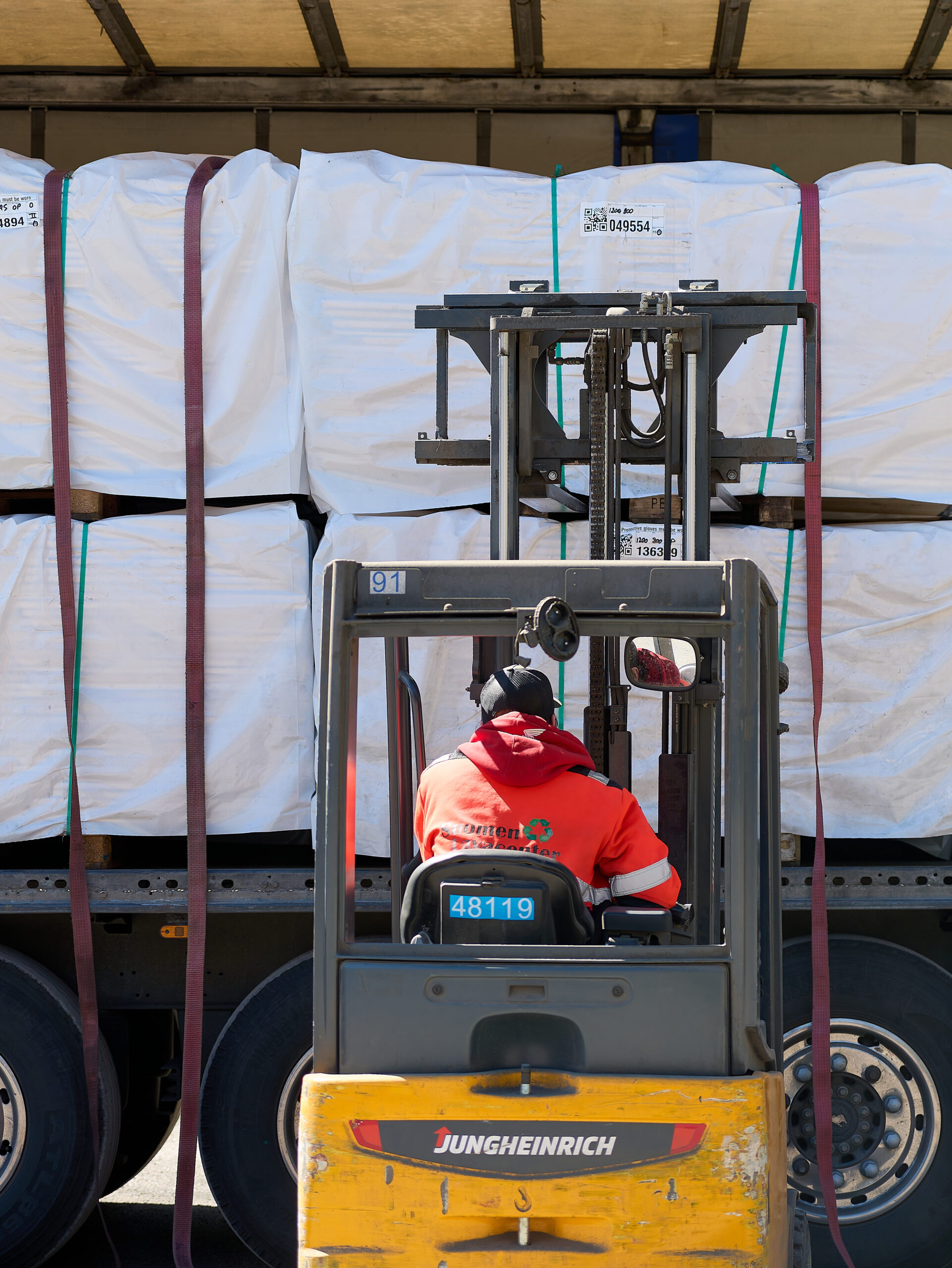
We cover load space utilisation and pallet quantities in more detail in the article how many pallets fit in a truck or container.
New or used collar?
Both work, and the choice depends on the use. A new collar is clean and of uniform quality, so it suits situations where the packaging is visible to the customer or is going for export. A used collar is cheaper and is perfectly adequate for your own internal transport and storage, as long as the structure is intact and the hinges work.
You can get both from us in one place, and we also buy back used collars when you have too many. That way packaging material keeps circulating instead of sitting idle in the warehouse.
Why a collar crate makes sense
- Adjustable height. The same solution adapts from a low load to a tall one simply by changing the number of collars.
- Affordable. Standard components are cheaper than a made-to-measure crate, and even cheaper when used.
- Space-saving. Collars fold flat, so they take up little space in storage and on return transport.
- Reusable. An intact collar lasts many cycles, which reduces packaging costs.
- Export-ready. When heat-treated and IPPC marked, the solution can also be used for shipments outside the EU.
Pallets and collars from one supplier
We deliver new and used pallets and pallet collars with our own trucks, including heat-treated ones for export. Tell us the product dimensions and the export destination, and we will suggest a suitable combination.


